


Why Your New Automatic Runs Fast, and When to Worry
A new automatic gaining a few seconds a day is normal, not faulty. Here is what accuracy you should expect, why it varies, and when something is actually wrong.

You set your new watch against your phone on Monday. By Friday it is a minute ahead. If your last watch was quartz, this feels like a fault, and the first instinct is usually to wonder whether you have been sold something that does not work properly.
You have not. A mechanical watch that gains a few seconds a day is behaving exactly as designed. Here is what the numbers actually mean, and where the line sits between normal and genuinely wrong.
What a Mechanical Movement Is Actually Doing
A quartz watch counts the vibrations of a crystal oscillating at over thirty thousand times a second, regulated electronically. It is a counting device and it is very good at it.
An automatic has no battery and no electronics. A coiled mainspring releases energy through a train of gears, and a balance wheel swinging back and forth on a hairspring meters that release into even beats. It is a spring, a wheel and a lever measuring time by physical oscillation.
That mechanism is affected by things software is not. Temperature changes the elasticity of the hairspring. Gravity pulls differently depending on which way the watch is lying. The mainspring delivers more torque when fully wound than when running down. All of these shift the rate slightly, and no amount of engineering removes them entirely. What good engineering does is keep the variation inside a predictable band.
The Numbers to Judge It Against
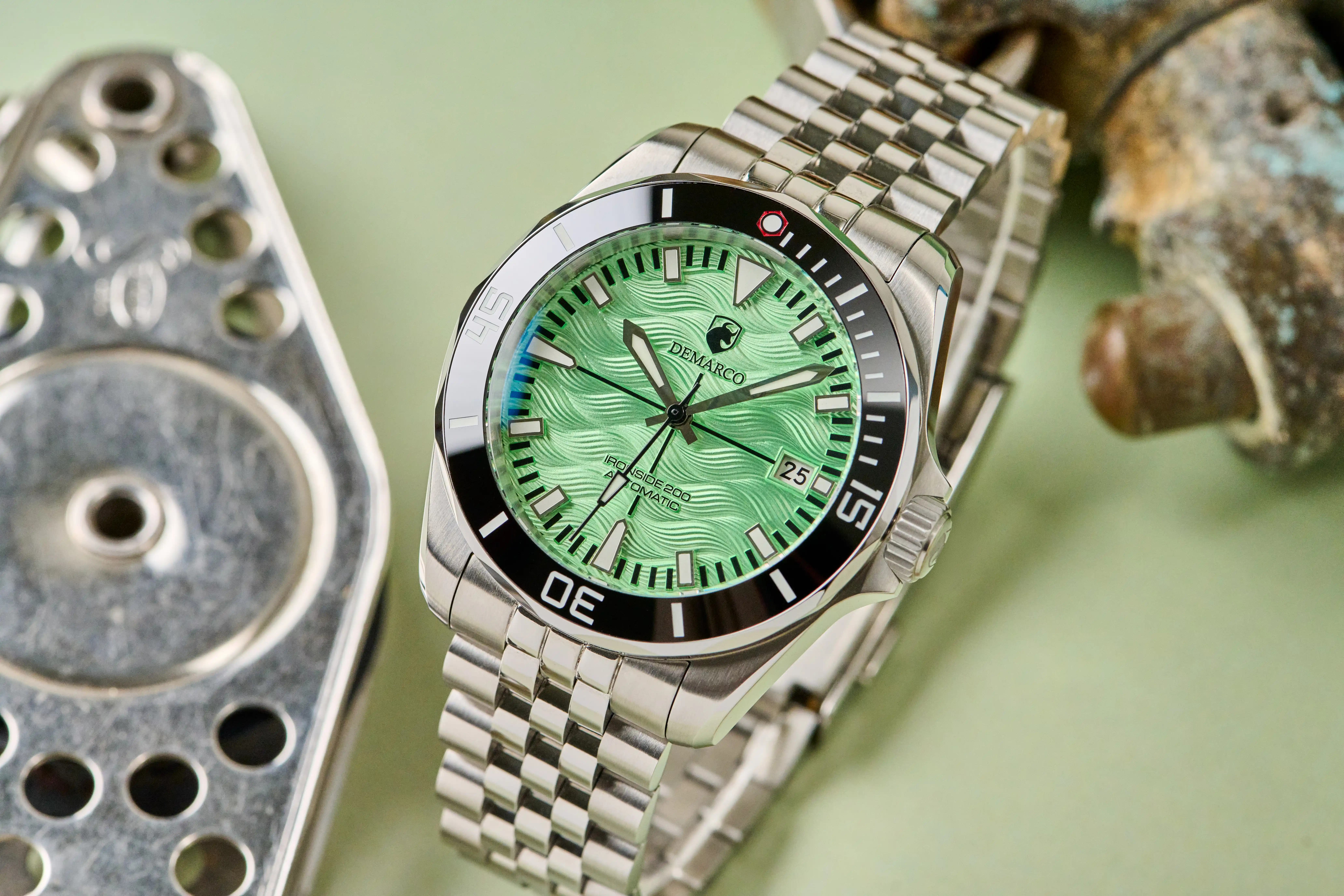
The Ironside 200 uses the Miyota 9015, a movement specified to run between roughly minus ten and plus thirty seconds per day. That is the manufacturer's tolerance, and it is the honest number rather than a flattering one.
In practice most 9015 movements settle considerably better than the outer edge of that band once they have been worn for a couple of weeks. Gaining five to fifteen seconds a day is entirely ordinary and is not a defect. Even a chronometer certified movement, which is a different and far more expensive class of thing, is permitted to run from minus four to plus six seconds a day. Perfect is not on the menu at any price in mechanical watchmaking.
It is also worth knowing that consistency matters more than the raw figure. A watch that reliably gains eight seconds every day is a well behaved watch. You can predict it, and you can correct it once a week in ten seconds. A watch that gains three seconds one day and loses twelve the next is the one worth looking at, because unpredictability suggests something is actually off rather than simply running fast.
The Things That Change Your Rate
How you store it overnight. Position genuinely matters. A watch left dial up will usually run at a different rate to one left crown down. If yours is gaining, try resting it in a different position overnight and give it a few days. Many people regulate their watch to near enough perfect purely by finding the storage position that offsets their daily wear.
How much you move. An automatic winds from the motion of your wrist. A desk bound day gives the rotor less to work with than a day on your feet, and a movement running on a partly wound mainspring behaves differently to a fully wound one. If you wear it only occasionally, giving the crown a few manual turns before putting it on evens this out.
Magnetism. This is the one people miss. Laptop speakers, tablet covers, phone cases with magnetic mounts, cabinet closures. A magnetised hairspring makes coils cling to each other, shortening the effective length and making the watch run dramatically fast, often by minutes a day rather than seconds. It is common, it is not damage, and a watchmaker demagnetises it in about a minute.
Temperature. A summer of genuinely hot weather or a cold snap will shift the rate a little. Nothing to do about this and nothing to worry about.
When Something Is Actually Wrong
Get in touch if you see any of the following. A sudden change of minutes per day, rather than seconds, which usually points at magnetism or a knock. A watch that stops while you are wearing it, which suggests the winding is not doing its job. A power reserve that has collapsed, meaning it dies within a few hours of coming off your wrist rather than running for most of a day. Or any grinding, rattling or roughness when you wind the crown.
Those are real symptoms. Gaining ten seconds a day is not.
Living With It
The practical routine is unglamorous and takes almost no time. Set it against a reliable source once a week, learn roughly what your watch does over seven days, and adjust for it. Most owners land on a Sunday evening habit and never think about it again.
If the rate genuinely bothers you, a 9015 can be regulated by a watchmaker to run considerably tighter than factory specification. It is a quick job and not expensive. But most people who spend a fortnight tracking their watch discover that once they have found the right overnight position, they are already within a handful of seconds a day and nothing needs doing at all.
Just received your Ironside 200 and want to check what you are seeing is normal? Get in touch and tell us what it is doing. There is a difference between a watch that needs attention and a watch that is simply mechanical, and it is usually easy to tell which is which.

14 DAY RETURNS

FREE GLOBAL SHIPPING
